Ginkgo trees an imported native relic
Last fall, as I was taking my usual walking route from Queen street through the entrance of the Glen Stewart ravine, I stopped to admire a couple of familiar young ginkgo trees all dressed up in their yellow fall finery. The pair have been getting a little crowded over the last couple of years, but even so, their continuing good health and vigour always reminds me of the tales of endurance and tenacity often told about this legendary species and its extraordinary ability to survive whatever nature and mankind can throw at it.
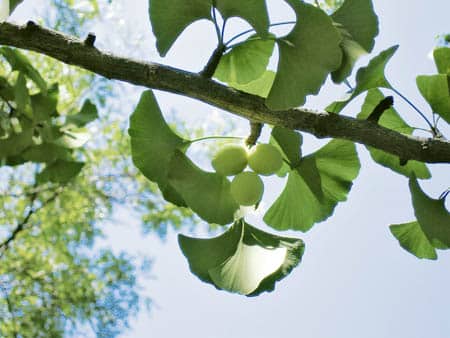
Ginkgo trees turn yellow in the fall, above left; female trees produce nuts with a foul-smelling covering, above.
PHOTOS: Steven Chadwick
For the last 250 million years or so, these ancients, thought to be one of the first seed-bearing trees on the planet, have survived munching by dinosaurs, weathered a couple of ice ages and hitched a ride across oceans as the continents drifted apart. And if that wasn’t enough, some of these fossil trees have single-handedly fended off urban encroachment and even survived the devastating effects of atomic bombs.
During a trip to Seoul, South Korea many years ago, I witnessed one example of a ginkgo’s battle against urban development after being guided to a nondescript neighbourhood near the northern outskirts of the city. There I saw a remarkable 800-year-old specimen that shared a small park with the tomb of King Yeonsan-gun, a well-known 16th century despot and apparently murderous veteran of the ruling game. The locals respected and worshiped the tree – unlike the king – and claimed it had magical powers that could predict wars by dropping branches, and warn of catastrophic events by making strange whistling sounds.
Unfortunately, the health of this venerable old ginkgo had been in serious decline for decades despite valiant attempts by arborists to support its heavy branches with cables and a variety of makeshift wooden poles. To add to its problems, severely compacted soil caused by the construction of two large residential buildings near the tree was interfering with its roots and threatening to deliver a final fatal blow. As I left the city, I wondered if it would make it through another decade. Fifteen years later I got my answer when I happened to stumble across a newspaper article describing the extraordinary measures taken to save this historic ginkgo. The paper reported that the city of Seoul had taken drastic action to ensure the tree’s survival by allocating $4.5 million to demolish the offending apartment buildings and relocate the residents. Today, thanks to this stunning example of putting nature first, the magical ginkgo still stands and has apparently regained much of its health.
Another more remarkable story of survival followed the tragic display of mankind’s inhumanity to the world and all living things when the Japanese city of Hiroshima and almost everything in it was destroyed by an atomic bomb. Among the vegetation that survived the devastating fireball were six ginkgoes, one of which was found scorched and leafless with its broken branches leaning precariously over the rubble of a temple just 1,000 metres from the centre of the blast. Miraculously, the tree began to bud two months after the event and quickly regained its full canopy of leaves. When the time came to rebuild the city, architectural features of new buildings were drastically altered to protect these important trees, with one restored building’s plans redesigned with a large hole in the roof to allow the branch of a surviving ginkgo to grow unimpeded. Today these famous hibaku trees (‘hibaku’ means ‘one who has seen radiation’) are treated as a symbol of peace and endurance, honoured with plaques that describe their terrifying history.
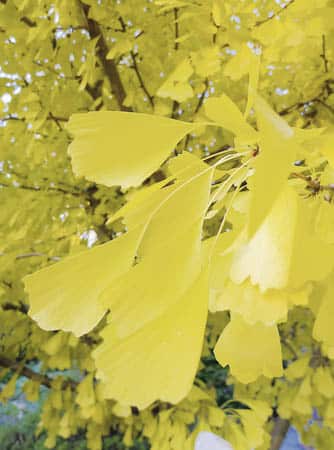
Closer to home, ginkgoes have become a favourite since being re-introduced in the middle of the 18th century partly because of their natural resistance to urban pollution, insect attack and disease, and the beauty of their unique light green bi-lobed leaves that turn a brilliant lemon yellow in the fall. The health benefits of their nuts are well-known with reported medicinal uses that can treat everything from senility to circulatory problems to tinnitus.
As indestructible and beautiful as ginkgoes may be, they are not all perfect. The trees are dioecious, which means individuals are either male or female and these days only the seedless males are planted in city parks and gardens. This is because the fleshy outer covering of ripened nuts from the female contain butyric acid which produces a spectacularly revolting aroma that I can only describe as a combination of rancid butter and something you might accidentally step on in the off-leash area. Definitely not a tree you want to have overhanging a sidewalk or backyard deck.
Even so, there are some mature females in parts of the city, most notably the large specimen in Allan Gardens and a pair in Edwards Gardens overlooked by a single male. The nuts are cherished in the Asian community as a tasty addition to deserts and salads and are regularly collected in the fall before they ripen and acquire their terrible smell. But care has to be taken when handling both the leaves and fleshy seed coat since they contain urushiol, the same substance that accounts for the ‘poison’ in poison ivy.
While advocates of native tree planting may not consider ginkgoes indigenous to Canada I suppose an argument could be made that the term ‘native’ all depends on which geologic perspective you are referring to since fossil records indicate that they populated every part of North America during the Mesozoic era – maybe even our own backyards – with petrified remains unearthed in such unlikely places as Saskatchewan and Alberta. Either way, millions of years after they first appeared on the planet it’s nice to see these survivors still thriving – in what might even be their prehistoric Toronto homeland.
Steven Chadwick is a professional gardener/horticulturist, and longtime Beach resident