Trees thought extinct thrive in Kew Gardens
It’s not often you have an opportunity to see a living fossil in your own backyard, but in Kew Gardens – about 90 m south of the Gardener’s Cottage and a good roll short of the bowling greens – stands a magnificent group of dawn redwoods that are happily thriving among the oaks and maples. Their gnarled fluted trunks and low-hanging outstretched branches make them look as though they would be more at home in Jurassic Park than a Toronto park. And with good reason – as recently as 1945 these trees were thought to be an extinct species, leaving behind just a few fossilized imprints of their foliage as the only evidence that they ever existed at all.
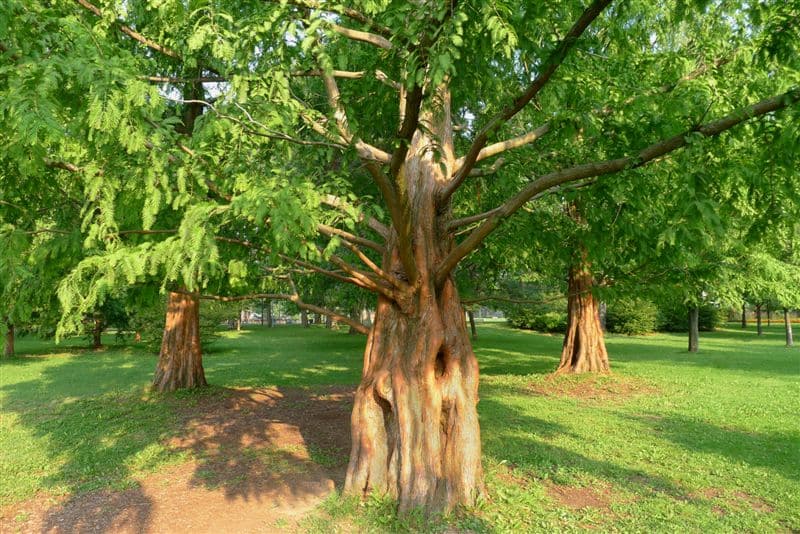
Dawn redwood trees in Kew Gardens
As a horticulturist and professional gardener, I always marvel at their extraordinary story of re-discovery and usually make a detour on my way to the boardwalk to admire these relics of the dinosaur age. I’m usually not alone – sometimes a dog walker or a jogger happens along to take a look and occasionally a conversation starts, as often happens when you find yourself standing around looking at trees with a stranger. And it’s not long before the inevitable question comes: do you know what kind of trees these are?
A distant relative of the well-known giant Sequoias of California, famously seen in those 1950s novelty postcards depicting tourists driving cars through their hollowed out trunks, the dawn redwood (Metasequoia glyptostroboides) has only recently joined the ranks of the few deciduous conifers (along with the Larch and Bald Cypress) that are found in North America. It was named in 1941 by palaeobotanist S. Miki, who had taken on the task of identifying and cataloging plant and foliage remains embedded in a cache of recently unearthed fossils. One particularly interesting sample of tree foliage fascinated Miki and his fellow botanists and they launched an exhaustive investigation to try to match the stone imprints to known living plants. Eventually Miki and his colleagues admitted defeat in their search and the tree was officially declared extinct. He named the samples Metasequoia (literal translation “like a sequoia”) before adding it to the growing pile of lost species.
The story would have ended there if it were not for a Chinese forester who, four years after Miki’s re-classification, happened to be surveying a remote area of Sichuan province for relocation sites financed by Chinese clients wary of the increasing Japanese occupation of China. A short time after beginning his exploration of the dense forested interior he stumbled across a village where he immediately noticed a large and unusual looking tree planted in front of a temple. Examining the deep emerald coloured feathered foliage and unusual form and twig arrangement he first thought he had come across a unique variety of cypress (which the redwood closely resembles), but he soon ruled that out after noticing anomalies in the leaf size and structure of the mysterious specimen. The local villagers appeared to have bestowed a religious significance on the temple tree and after noticing his curiosity led him to a small stand of similar trees growing in a densely wooded area nearby. Baffled, he temporarily abandoned his original mission and began collecting foliage samples which he sent to Beijing university for identification. Coincidentally a botanist there had recently read the Miki description of lost species and when he compared the leaf and twig samples to the fossil descriptions they matched perfectly.
Metasequoia glyptostroboides had been brought back from extinction.
Even with the Pacific war in full swing the discovery of an extinct species was big news and word travelled quickly around the world causing great excitement among botanists and the scientific community on both sides of the conflict. As the war came to an end an expedition sponsored by the Arnold Arboretum and Harvard University was assembled and dispatched to collect seed samples, but it wasn’t until 1947 that the team managed to travel inland to examine the original discovery site. When they returned to the United States the researchers discovered that their newly collected seeds proved to be extremely viable and quick to germinate and it wasn’t long before seedlings and small saplings were being distributed to botanical gardens and nurseries where they were nurtured and later sold as ornamental and landscape curiosities.
Today, dawn redwoods are a common sight in parks and gardens in North America and Europe and a few brave souls have even installed these living fossils in their back gardens. However, I wouldn’t rush out to the garden centre just yet. These fast-growing trees need brontosaurus-sized accommodations since fully mature specimens have been recorded as having a height of 40 m and branches spanning an area of 10 m.
In addition to the group in Kew Gardens, there are some excellent examples of dawn redwoods in Toronto. High Park has a gnarled and weather-beaten metasequoia on the shore of Grenadier pond (just behind the carpet bed display) accompanied by a group almost hidden in a forested area nearby. However, one of the oldest and most spectacular Toronto specimens resides in Edwards Gardens.
When it was planted in 1960, legend has it that the gardener of the day positioned the sapling in such a way that between 7:20 to 7:45 am on June 20 (his wife’s birthday), the entire tree is illuminated by the rising sun. Sadly, a careless film crew recently removed some of its large lower branches while they were shooting nearby – a wounding that can sometimes prove fatal for the older and more closely related offspring of the original Sichuan genetic pool. Nevertheless, the main form is still intact and it stands majestically at the top of the hill on the path leading to the west side of the park opposite the children’s garden. Even though 50 years of nearby tree and shrub growth have slightly diminished the morning illumination effect, this particular living fossil continues to stand as a testament to one gardener’s devotion and creativity.